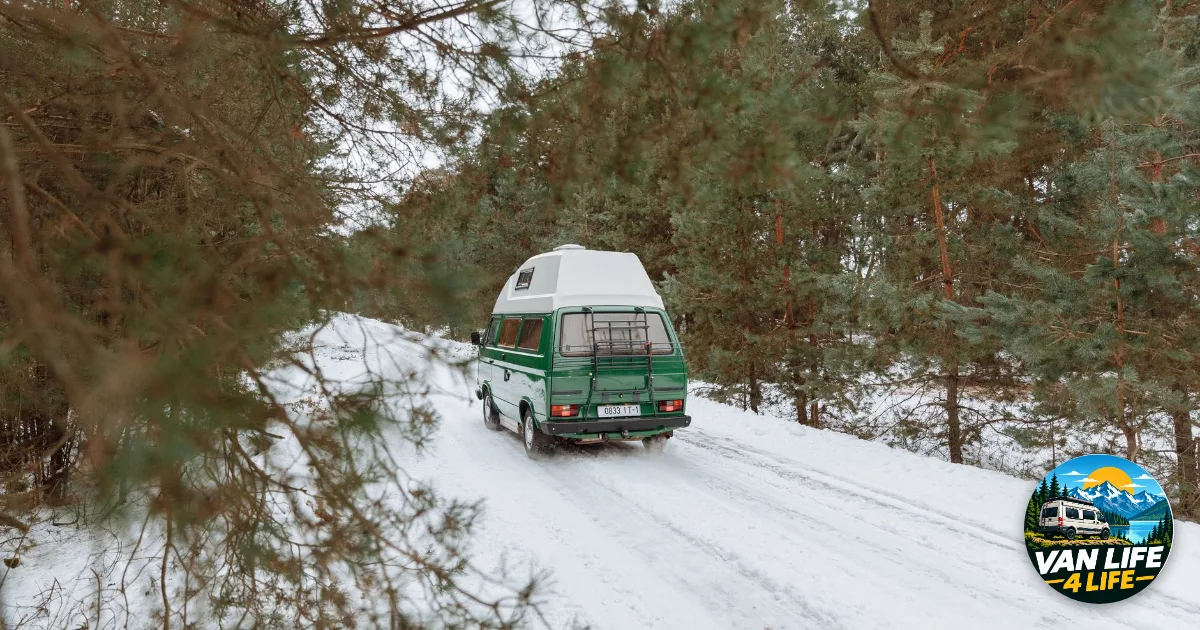
Winter van life means getting four things ready: the right tyres and snow chains if you head for the mountains, a lithium battery that will not charge below a certain temperature, water that freezes in the pipes, and safe heating backed by a carbon monoxide alarm. If you drive to the French Alps or Pyrenees between 1 November and 31 March, winter tyres or chains are compulsory in the mountain areas concerned, and that is often the first thing people find out too late.
1. In France’s mountain areas, winter tyres with the alpine symbol, or chains in the boot.
2. Check the minimum charging temperature of your lithium battery on its spec sheet.
3. Drain the water system if the van sits in the cold without heating.
Driving rules for winter van life in the UK and France
In the UK, the Highway Code’s rules for driving in adverse weather tell you not to drive in snow and ice unless your journey is essential, to clear all snow and ice from every window, and to keep your lights clean and number plates visible. They warn that stopping distances can be ten times greater than on dry roads, and ask you to brake progressively on the straight before you reach a bend.
France goes further. Decree 2020-1264 of 16 October 2020, made under the Loi Montagne II, lets each département’s prefect list the communes where winter equipment is compulsory. There, cars, light vans and motorhomes must carry removable snow chains for at least two driven wheels, or fit winter tyres on at least two wheels of each axle, from 1 November to 31 March. Since 1 November 2024, a winter tyre must carry both the alpine symbol and an M+S, M.S or M&S marking. France’s road safety leaflet adds a 50 km/h limit on chains and bans their use on dry roads.
Lithium batteries and winter van life
Cold mainly limits how LiFePO4 batteries charge. Victron Energy’s spec sheet for its Smart lithium batteries gives a discharge range of -20 °C to +50 °C, but a charge range of only +5 °C to +50 °C. American maker Battle Born puts its charging limit at around -4 °C, unless the battery has internal heating. Limits differ between brands, so read the sheet for your own battery.
Capacity also drops with temperature. Victron rates its 12.8 V 100 Ah battery at 100 Ah at 25 °C, 80 Ah at 0 °C and 50 Ah at -20 °C. Keep the battery inside the heated part of the van, and redo your power budget with that reduced capacity before a trip into hard cold. Our guide to sizing a van battery bank shows how.
Keeping water from freezing
Water freezing in the system can damage it, which is why Truma fits its Combi heaters with a FrostControl drain valve that opens and empties the water container automatically below about 3 °C. In a self-built van without that feature, do the same by hand: if the van will sit in the cold unheated, drain the system, open the taps and the pump, and leave the tank empty.
Fill the fresh water tank only when you are ready to use the van and the heating is running, and keep the water container inside the heated living space where your layout allows it. For winter van life on the move, that simple habit saves most freeze problems.
Heating, carbon monoxide and damp
Winter van life means running a heater, and with it the risk of carbon monoxide. The National Caravan Council warns that portable gas heaters designed for outdoor use must never be used inside a campervan, and urges van users to test and maintain their carbon monoxide alarm regularly. Choose an alarm designed for leisure vehicles.
Cold also makes condensation worse, because the van’s metal walls chill quickly. Our article on campervan condensation covers the ventilation to keep even when it freezes, and our comparison of cork and Armaflex insulation helps you deal with cold walls.
Diesel for winter van life in the mountains
Diesel thickens in hard cold as paraffin wax crystallises. TotalEnergies rates the cold filter plugging point of its Excellium Grand Froid diesel at -21 °C, against -15 °C for standard French winter diesel. That fuel feeds the engine and any diesel heater drawing from the same tank, so if you are driving up to a ski resort in France, fill up before the climb.
Your winter van life checklist
| Use | Priorities |
|---|---|
| Ski weekends | Winter tyres or chains in France, CO alarm, water drained on your return |
| Regular winter trips | Battery inside the heated space, room-sealed heater, daily ventilation |
| Full-time living | Continuous insulation, heated or protected lithium battery, winter diesel at altitude |
Winter van life starts with the legal side, tyres and chains, then with what costs most if you forget it: a battery charged below its minimum temperature or a frozen water system. The rest you fine-tune over the first cold nights.