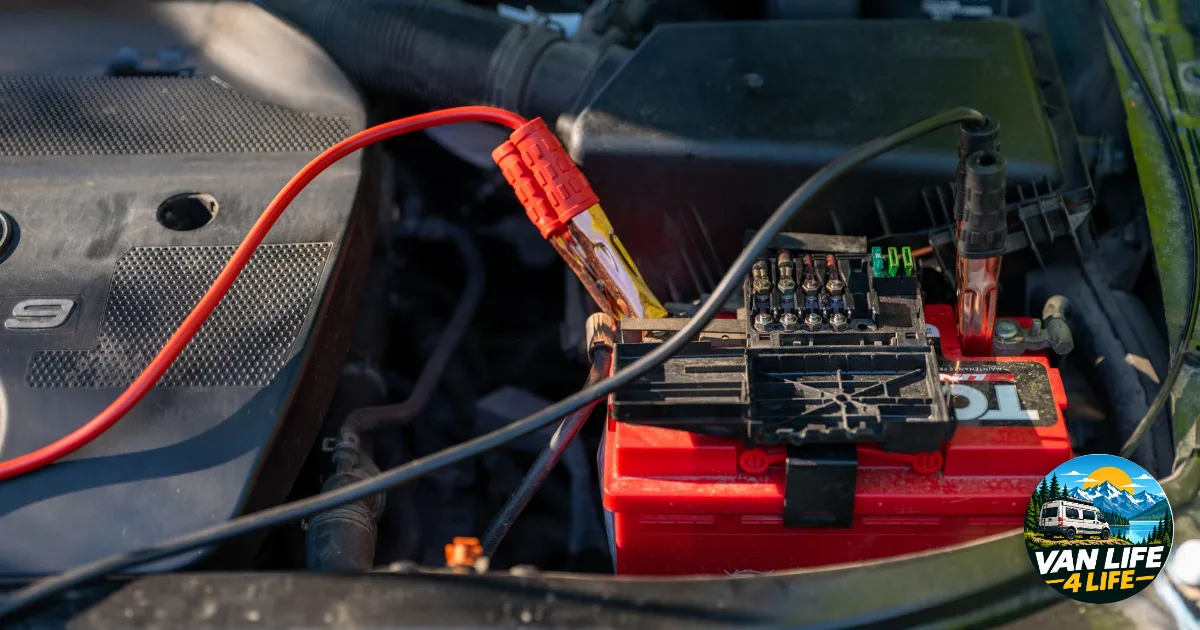
A DC-DC charger, sometimes called a battery-to-battery charger, charges your leisure battery with a proper charging profile whatever voltage the alternator is putting out. A split charge relay simply connects the two batteries once the voltage rises. On a modern van with a smart alternator, a DC-DC charger is the safe choice, and with a lithium battery it becomes essential. A relay still makes sense on an older van with a conventional alternator and a lead-acid leisure battery.
1. Euro 6 van or an alternator managed by the vehicle: fit a DC-DC charger.
2. LiFePO4 leisure battery: fit a Charger to protect the alternator and charge on the right profile.
3. Older van with a conventional alternator and lead-acid battery: a split charge relay can do the job.
How a split charge relay works
A split charge relay, also called a voltage-sensitive relay, is a switch driven by voltage. Victron Energy’s datasheet for its Cyrix-ct battery combiner describes the typical set-up: the alternator is wired directly to the starter battery, and when the Cyrix senses that the starter battery has reached its connect voltage, it engages to allow parallel charging of the other batteries. On this model it connects between 13 and 13.8 V and disconnects between 11 and 12.8 V.
The relay converts nothing: your leisure battery gets whatever the alternator delivers. The same Victron datasheet flags two weaknesses of ordinary relays. Some disconnect a battery during a short but heavy load, and a relay may fail to connect a large, discharged battery bank because the voltage drops below the disengage value as soon as the batteries are joined.
Why a DC-DC charger suits modern vans
The trouble starts with smart alternators. Victron’s manual for the Orion-Tr Smart charger explains that on Euro 6 vehicles, the alternator management system decides while you drive whether the alternator is needed, based on the vehicle’s electrical demand and how much energy it can recover under braking. The charge voltage then varies roughly between 12.5 and 15 V on a 12 V system, and the alternator can be switched off completely for a while.
Sargent Electrical Services, the British motorhome electrics maker, sums up the consequence: leisure batteries can be undercharged when using a split charge relay with a smart alternator. Sargent adds that during braking a smart alternator can push its output as high as 15 V or more, which can overcharge some leisure batteries such as gel. A Charger takes whatever the alternator and starter battery can supply and converts it into the right voltage and current for the leisure battery.
Lithium adds one more reason. Victron notes that controlled charging also protects the alternator in lithium systems, where direct charging can overload it because of the low impedance of a LiFePO4 battery. Sargent makes the same point about limiting current into a flat lithium battery to avoid blown fuses. Our guide to sizing a van battery bank helps you pick that battery.
Choosing the current rating of a DC-DC charger
There is no universal rule, but manufacturers give reference points. German maker Votronic recommends its VCC 1212-30, adjustable up to 30 A, for batteries of 60 to 200 Ah. CTEK rates its D250SE at up to 20 A for lead-acid or lithium batteries from 40 to 300 Ah. Victron rates its Orion-Tr Smart 12/12-30 at 30 A continuous with 87% efficiency.
That efficiency matters for the wiring: to deliver 30 A, a Charger draws more from the starter battery side. Victron says a 12/12-30 pulls about 35 A from its input. It is that input current that sets the cable size and fuse rating on the starter battery side.
Wiring a DC-DC charger: cable sizes and fuses
Victron’s installation manual gives a 60 A battery protection fuse for the Orion-Tr Smart 12/12-30, with a minimum cable size that depends on cable length. In a van, the starter battery sits under the bonnet or the driver’s seat and the leisure battery is often at the back, so the run is rarely short.
| Cable length | Minimum cross-section (Victron, 12/12-30) |
|---|---|
| 0.5 m | 6 mm² |
| 1 m | 10 mm² |
| 2 m | 10 mm² |
| 5 m | 16 mm² |
| 10 m | 16 mm² |
These figures apply to that model only: every maker publishes its own table, and Sterling’s manual gives different sizes for its BB1230, for instance. Victron also specifies flexible multi-strand cable and recommends mounting the unit close to the battery, but never directly above it. To see where the DC-DC charger sits in the wider system, check our campervan wiring diagram.
Voltage drop and protecting the starter battery
Cable length affects more than cable size: it also lowers the voltage that reaches the charger. Victron’s manual works through an example, reproduced here as published.
| Input (Victron example) | Value |
|---|---|
| Cable run | 5 m of 16 mm² |
| Cable resistance | about 1.1 mΩ per metre |
| Current drawn by a 12/12-30 | about 35 A |
| Voltage drop | 385 mV |
The charger therefore sees a lower voltage than the starter battery holds, which can trigger its engine-off detection too early. The manual allows for this when setting the thresholds, and a thicker cable reduces the drop.
The charger also looks after the starter battery. In charger mode, the Orion-Tr Smart stops charging when its input falls to 12.5 V and restarts at 12.8 V on its default settings. Sterling’s BB1230 starts by default once the input exceeds 13.2 V and switches off if it stays below 13.0 V for more than 240 seconds. Those thresholds stop it draining the engine battery to the point where the van will not start.
Switching on: voltage sensing, D+ or an engine signal
A DC-DC charger needs to know when the engine is running. By default the Orion-Tr Smart detects it from voltage: on its smart alternator setting it starts at 14 V and shuts down if the voltage stays below 13.1 V for more than a minute. Victron warns that on a Euro 6 vehicle, a switched-off alternator lets the starter battery fall back to around 12.6 V, so the charger can wrongly conclude the engine has stopped while you are still driving.
The D+ wire that used to show the alternator was active is often no longer provided on Euro 6 vehicles, according to Victron. The company also advises against using the ignition feed to enable charging, because the charger would then drain the starter battery with the ignition on and the engine off. The most reliable source is an engine-running signal from the vehicle itself. Sterling’s BB1230 offers a dedicated mode for Euro 6 engines that start with the alternator off.
Your shortlist: DC-DC charger or relay
| Your van | Our advice |
|---|---|
| Older van, conventional alternator, lead-acid battery | Split charge relay, the simplest option |
| Euro 6 van, lead-acid or AGM battery | DC-DC charger rated 20 to 30 A |
| LiFePO4 battery, any vehicle | DC-DC charger with a lithium profile, sized to the battery capacity |
If your van is Euro 6 or you are moving to lithium, go straight for a DC-DC charger and size it from your battery capacity and cable run. Then top up charging on the move with solar panels for the days you stay parked.