The amount of solar power your van needs comes straight from your daily consumption: you convert it into amp-hours, apply a rule of thumb for how much each installed watt harvests, then adjust for the season you travel in. You size the panels from what you use, and the roof space you have only comes in afterward, as an installation constraint.
1. Start from your daily consumption in amp-hours, worked out appliance by appliance.
2. Baseline: about 4 W of panel to harvest 1 Ah a day, following the FarOutRide method.
3. Adjust with a factor between 0.8 and 1.2 depending on whether you chase the sun or travel in winter, then check real output for your area.
Begin with what your appliances use each day
Sizing solar power starts from your appliances’ daily consumption in amp-hours. If you have already worked through our guide on how to size a van battery bank, you have that figure in hand: it is the result of the second step, before the margin for days without charging is applied.
In that guide’s example, a typical setup (compressor fridge, lighting, roof fan, laptop, phone charging and water pump) used 603 Wh a day, which works out to 47.1 Ah on a 12.8 V lithium battery. We carry that number over here to work out how much solar power to install. Swap in your own figure, because a van without a fridge or a laptop will use far less, and the result shifts accordingly.
Battery and panels answer two different questions. The battery stores enough energy to get through several days without charging, while the panels have to replace, every day, what you used. That is why you size them separately, from the same starting consumption.
The 4 W per amp-hour rule for sizing solar power
FarOutRide, one of the most widely used build guides for van electrical systems, gives a simple rule in its guide to sizing a van electrical system: every 4 W of solar panel harvests roughly 1 Ah per day. The wattage to install is therefore your daily consumption in Ah multiplied by 4.
The same guide then adjusts that result for how you travel: a factor of 0.8 for sun seekers, 1 for its recommended setup, and 1.2 for snow chasers. Applied to our example of 47.1 Ah a day, that gives the following panel sizes.
| Travel style | Math | Panel wattage |
|---|---|---|
| Sunny trips | 47.1 × 4 × 0.8 | 150.8 W |
| Recommended use | 47.1 × 4 × 1 | 188.4 W |
| Winter travel | 47.1 × 4 × 1.2 | 226.1 W |
FarOutRide applies the same rule to its own build: with 71 Ah of daily use, the recommended math comes out at 284 W, and the guide ends up choosing two 175 W panels paired with a Victron 100|30 charge controller. Rounding up to the next solar power size on sale is the sensible move.
How season and location change your solar output
The 4 W per amp-hour rule is a starting point, and what a panel actually produces depends heavily on where you are and what month it is. The FarOutRide authors point out that in December and January, under their conditions, solar output becomes close to nonexistent because of the low sun angle and snow. Extra panels mostly help in late autumn and early spring.
To find out what a panel will produce where you travel, the go-to tool is PVGIS, published by the European Commission’s Joint Research Centre. It provides solar radiation and photovoltaic performance data for any location in the world except the poles, free and with no registration. Enter the area you travel in most and you can compare estimated output month by month, and see whether your calculated solar power still holds up in winter.
If the numbers show your panels will fall short in the dark months, you have two levers: a bigger battery to bridge the gaps between sunny days, or charging while you drive. FarOutRide builds that alternator charging into its own battery sizing recommendations.
Mounting panels on the roof without losing output
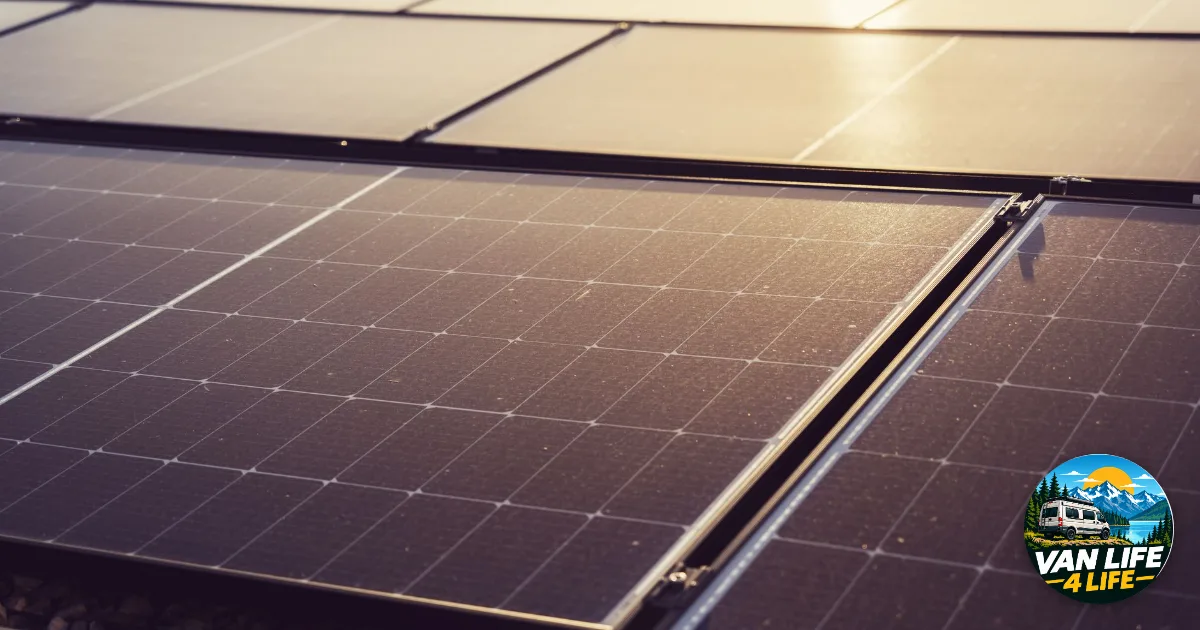
On a van, solar power almost always comes from panels lying flat on the roof, since you cannot tilt them towards the sun. Two things then weigh on output. The first is shade: a roof vent, a rack or a roof box casting a shadow over part of a panel cuts what it produces, so it pays to lay things out to keep the panel surface clear. The second is space: several smaller panels sometimes fit around vents and roof gear better than one large one.
Panels never connect straight to the battery. They go through a charge controller sized for the total installed wattage and the panel voltage, so check the controller’s maximum ratings on its spec sheet before you buy your panels, to keep the whole setup compatible.
A full worked example, from appliance list to solar power
Let’s take the opening example all the way through. The appliance list adds up to 603 Wh a day, 47.1 Ah on a 12.8 V lithium battery. The traveler mostly drives from April to October, so the factor of 1 fits, meaning 188.4 W of solar power, rounded up to the next setup actually available, one panel or several smaller ones depending on roof space.
If that same traveler then decides to head out in November, adding a panel is not enough on its own: redo the math with the winter factor, look at PVGIS for those months, and check that the battery holds enough days without sun.
Check real output once everything is installed
The math gives you a starting point, and real use tells you whether it was right. If your charge controller shows daily yield, in watt-hours or amp-hours, write it down for a few weeks, on sunny and overcast days alike, and compare it with the consumption from your original appliance list.
If production comfortably covers your use on sunny days but collapses as soon as the sky clouds over, your setup is sized for the fair-weather season. If the battery struggles to recover even in summer, look first for shade on the roof or an appliance you left off your list, before concluding that you are short on solar power.
Tracking output has one more benefit: it gives you your own real consumption, far more reliable than example values or the wattage printed on labels. That is the figure to start from if you ever expand the system.
Where your van’s solar power should land
| Travel style | What to aim for |
|---|---|
| Sunny trips | Daily Ah × 4 × 0.8, so 150.8 W on the example |
| Regular use | Daily Ah × 4, so 188.4 W on the example |
| Winter and full-time living | Daily Ah × 4 × 1.2, so 226.1 W on the example, checked month by month in PVGIS |
Rerun the math with your own consumption, round up to the next panel size on sale, then check your area’s output for the months you travel most. Battery and solar power are always sized together: one stores, the other recharges, and the balance between them sets how long you can really stay off-grid.